

When Luc de Meo was CEO of French automaker Renault, he ordered, “Develop an electric vehicle under 20,000 euros within two years.” The headquarters’ development team responded, “Impossible,” but Chinese engineers said, “No problem.” This marked the beginning of Renault’s decision to establish a development center in Shanghai, China.
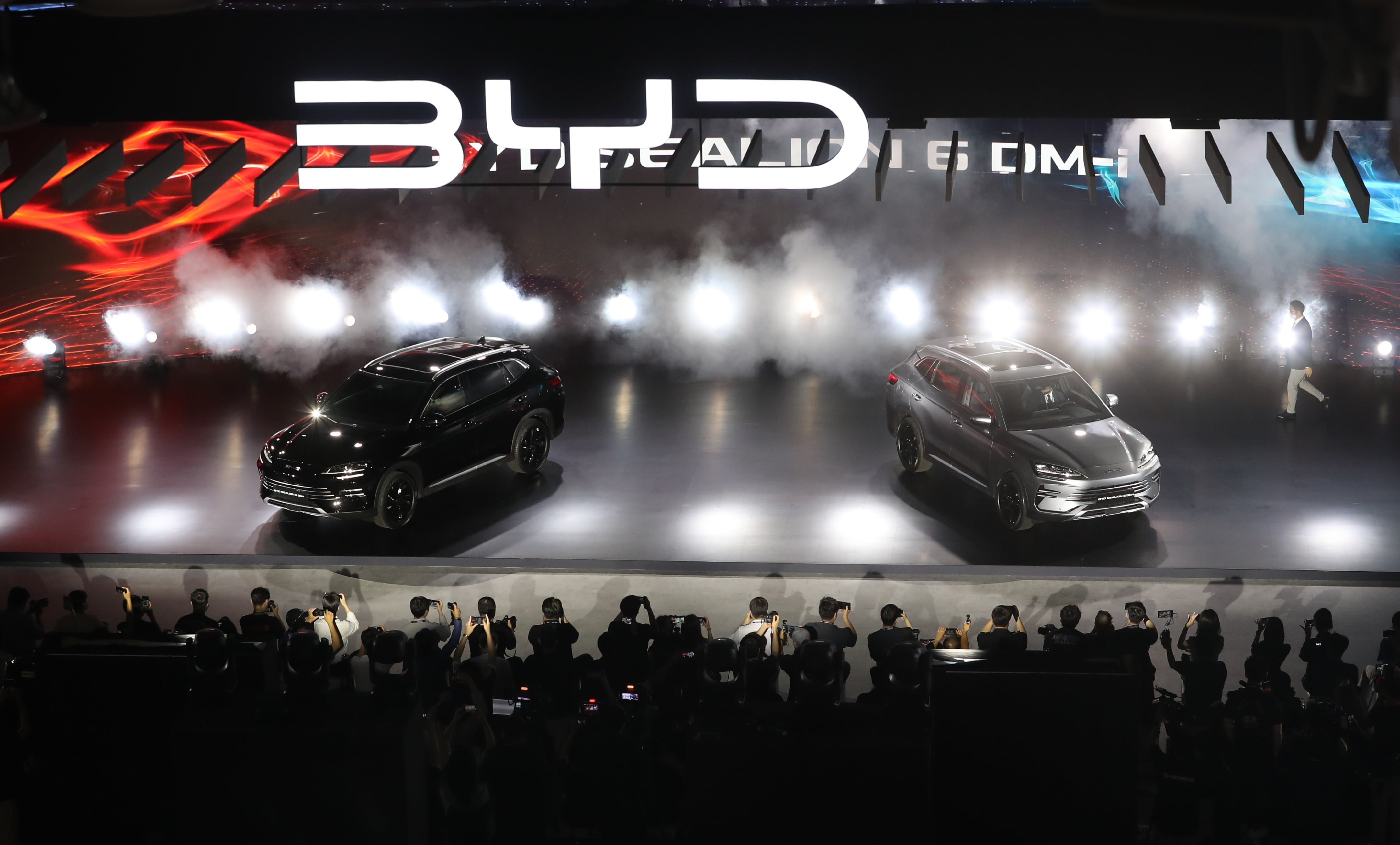
Global automakers are rushing to set up development centers in Shanghai, Guangzhou, and other Chinese cities. This is to absorb China’s efficient electric vehicle supply chains, formidable development speed, and technological capabilities to strengthen competitiveness. A market once targeted for sales has become a place to learn how to build cars. Chinese electric vehicles, packed with this know-how, are flooding the South Korean market. Chinese automaker BYD surged to fourth place among imported car brands in the first half of this year, while Tesla models mass-produced at the Shanghai Gigafactory are sweeping the Korean market.
A domestic automotive industry expert likened the onslaught of Chinese electric vehicles to a “vehicle swarm tactic” (車海戰術). This is not the same as the old low-cost volume strategy. A business insider who recently tested various Chinese electric vehicles on-site remarked, “There was no unevenness or poor craftsmanship. It wasn’t the Chinese-made cars we used to know.” He confessed, “I felt despair wondering if Korean cars could win.”
China’s electric vehicle supply chain remains resilient even amid global inflation. U.S. research firm Rhodium Group analyzed that Chinese automaker BYD can reduce production costs by approximately 4,700 dollars per vehicle compared to Tesla, which also produces locally in China. Government subsidies account for only about 5% of total costs. The real secret behind the overwhelming cost gap lies in the structure of in-house production of core components and highly efficient R&D and management capabilities.
South Korea, which once could not even produce a single engine, achieved the miraculous feat of elevating its indigenous automotive brand to a global leader. This was thanks to relentless efforts toward quality and a robust domestic market. Korean automakers used this foundation to challenge overseas markets and invest in future technologies. However, this safety net is now shaking. In the second quarter of this year, Hyundai Motor saw its operating profit drop by over 20% despite recording its highest-ever quarterly sales. This was due to parts supply disruptions, rising raw material prices, and intensified competition. Yet, the company cannot fully pass these increased costs to vehicle prices. This is because Chinese electric vehicles are continuously lowering the price ceiling. As Chinese electric vehicles erode profit margins, Korean automakers’ capacity for innovation to prepare for the future will inevitably dwindle.
If the Chinese automotive onslaught continues, is there any guarantee South Korea won’t follow the path of Britain, which once reigned as an automotive kingdom but declined? Can the grim scenario of Ulsan, the heart of South Korea’s automotive industry, turning into a “Korean Rust Belt” and being filled with Chinese-funded factories be dismissed as mere speculation? If the U.S. market, which currently blocks Chinese electric vehicles, is breached, the day of crisis will arrive much sooner.
Wan Gang, a former Audi engineer from Germany, proposed in 2000, “Let’s change the game with electric vehicles.” He later became China’s Minister of Science and Technology and spent 11 years turning this vision into national policy. This was the core driving force behind China’s rise to a global electric vehicle powerhouse, despite having no name in the century-long history of automobiles. In contrast, South Korea excluded a proposed tax credit for electric vehicle production—a rare instance of labor and management agreeing—from government discussions. While China imposes a 15% tariff on Korean cars, South Korea applies only an 8% tariff on Chinese vehicles. Even so, South Korean government subsidies are provided indiscriminately to both domestic and Chinese-made vehicles.
Companies alone cannot withstand a national-scale vehicle swarm tactic. The game could end before Hyundai’s trump card, the humanoid Atlas, even appears on the production floor. Correcting the tilted playing field is the minimum role the government must play immediately.



Leave a comment