
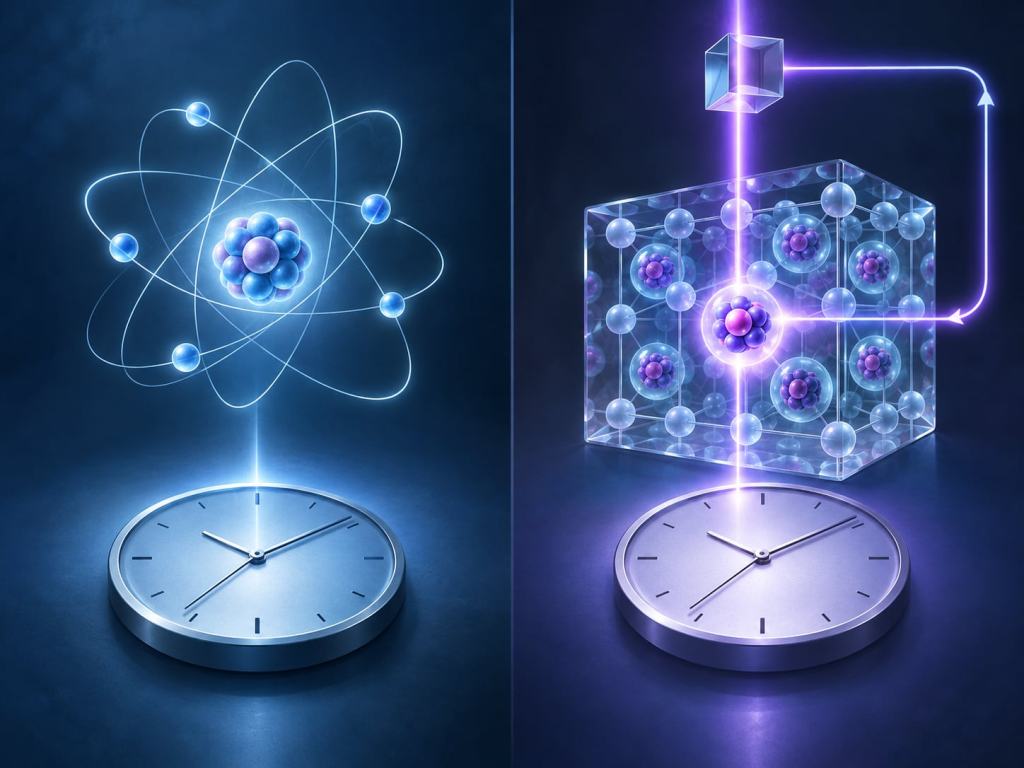
A “nuclear clock” that uses changes in the energy of the atomic nucleus itself as a time standard has been implemented for the first time in a working form. Chinese and European research teams independently developed nuclear clocks using thorium-229 nuclei and announced their results in the international academic journal *Nature* on October 8. While it is not yet more precise than the most accurate optical atomic clocks, it marks the first step toward using atomic nuclei as the actual standard for clocks.
The most accurate clocks currently are optical atomic clocks. They measure time based on the highly consistent light vibrations that occur when electrons in an atom change energy states. The highest-level optical atomic clocks are so precise that even after operating for hundreds of billions of years, the error would be less than a second. However, electrons can be affected by external electric fields or thermal radiation. In contrast, atomic nuclei are about 100,000 times smaller than atoms, making them relatively less susceptible to such external influences.
The key material for this nuclear clock research is thorium-229. Most atomic nuclei require too much energy to change states, making them difficult to handle directly with lasers. However, thorium-229 has an exceptionally low energy difference of about 8.4 electron volts (eV), allowing its nuclear energy state to be changed with a vacuum ultraviolet laser with a wavelength of approximately 148 nanometers.
The two research teams that each published papers in *Nature* both placed thorium-229 inside calcium fluoride crystals, fired lasers at them, and measured the light absorption signals of the atomic nuclei. They created a device that detects deviations in the laser frequency from the thorium nucleus’s unique transition frequency and realigns it. This implemented a “clock pendulum” that continuously corrects the laser based on nuclear transitions.
The Chinese research team’s nuclear clock achieved a frequency instability as low as one part in 1,000 trillion by extending the measurement time. The European team successfully operated their nuclear clock continuously for about a day. However, both devices are not yet more stable than the current highest-level optical atomic clocks. *Nature* evaluated this achievement as a “milestone in metrology” for realizing an actual working nuclear clock.






Leave a comment