
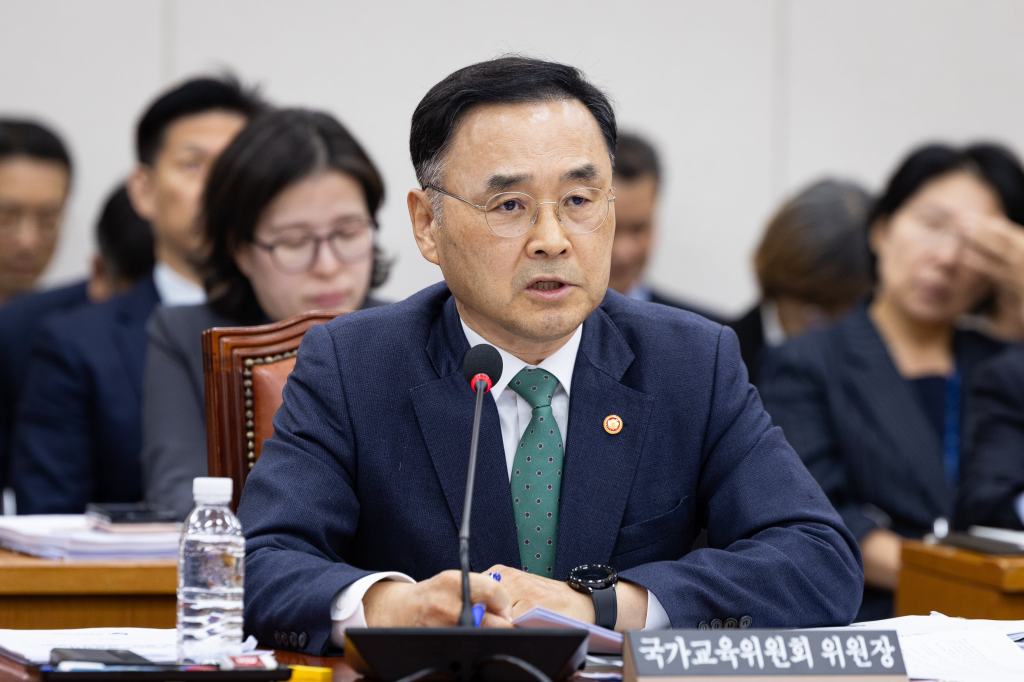
The presidential National Education Commission (NEC) is considering a plan to postpone the announcement of a draft “mid- to long-term education plan” that includes college entrance exam reforms.
On the 7th, during a parliamentary audit by the National Assembly Education Committee, Rep. Lee Ju-young of the Reform Party pointed out, “There are concerns about the introduction of essay-type and descriptive questions in the CSAT, regardless of political parties,” to which NEC Chairman Cha Jeong-in responded, “I am well aware that lawmakers and the public are very concerned.”
Chairman Cha explained, “We focused on public deliberation regarding the college entrance exam reform in August, but some NEC members suggested that a more thorough process of listening to public opinion is needed. Therefore, I mentioned to the members that rather than announcing the draft in its current state with insufficient public deliberation, it would be appropriate to conduct further deliberation specifically on the college entrance exam before releasing the draft.”
The mid- to long-term education plan establishes the overall direction of South Korea’s education system, from elementary, middle, and high schools to universities. The plan to be announced will apply for the next 10 years, from 2028 to 2037. The NEC had planned to publicly release the draft in late October, gather opinions, and finalize it in March next year. However, discussions are underway to delay the draft announcement itself due to insufficient public deliberation on the college entrance exam reforms included in the draft.
Chairman Cha stated, “The members are thoroughly discussing the timing of the draft announcement and finalization.”
Although the NEC was launched in September 2022, the draft announcement schedule has been repeatedly postponed from September 2024 to January and May 2025 due to internal conflicts within the NEC. Since Chairman Cha has repeatedly mentioned announcing the draft this month, further delays could make it difficult to avoid criticism of the NEC’s ineffectiveness.
Currently, the NEC is discussing, through a special committee on college entrance exams and other channels, the introduction of essay-type and descriptive questions in the CSAT and the full transition of all CSAT subjects and high school grades to absolute evaluation. Chairman Cha stated during a presidential work report in August, “Multiple-choice questions cannot foster creativity or critical thinking,” and emphasized the need to introduce essay-type and descriptive questions in the CSAT.
Regarding concerns that the introduction of essay-type and descriptive questions in the CSAT could exacerbate private education, Chairman Cha stated, “If school grades and the CSAT content are aligned, it could become a breakthrough in resolving private education issues.”
Chairman Cha explained, “The high dependence on private education for current essay exams is because schools do not prepare students for university-specific essay exams at all.”





Leave a comment