
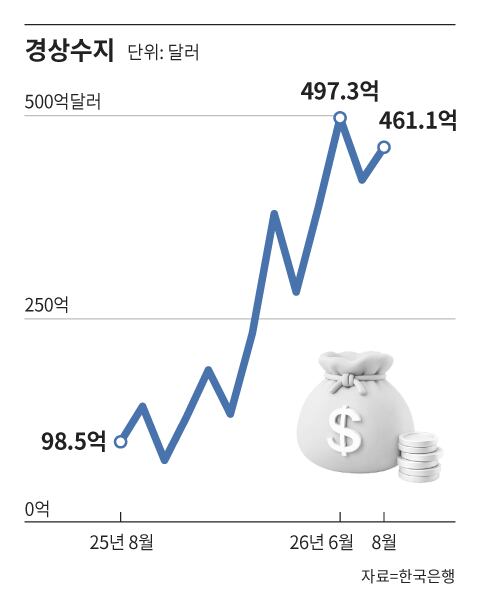
The Bank of Korea announced on the 8th that the current account surplus for August reached 46.11 billion dollars, an increase of 36.27 billion dollars from the same month last year. This marks the 40th consecutive month of surplus. Driven by the U.S. artificial intelligence (AI) boom, exports of Korean semiconductor giants surged, pushing the surplus above 40 billion dollars for three consecutive months. August’s surplus, the largest on record for the month, exceeded July’s 42.08 billion dollars, ranking as the second-highest surplus ever.
The cumulative current account surplus from January to August stood at 279.2 billion dollars, 2.3 times the annual surplus of 123.0538 billion dollars recorded for all of last year. Compared to the same period last year, it was approximately four times higher than the 69.67 billion dollars reported then.
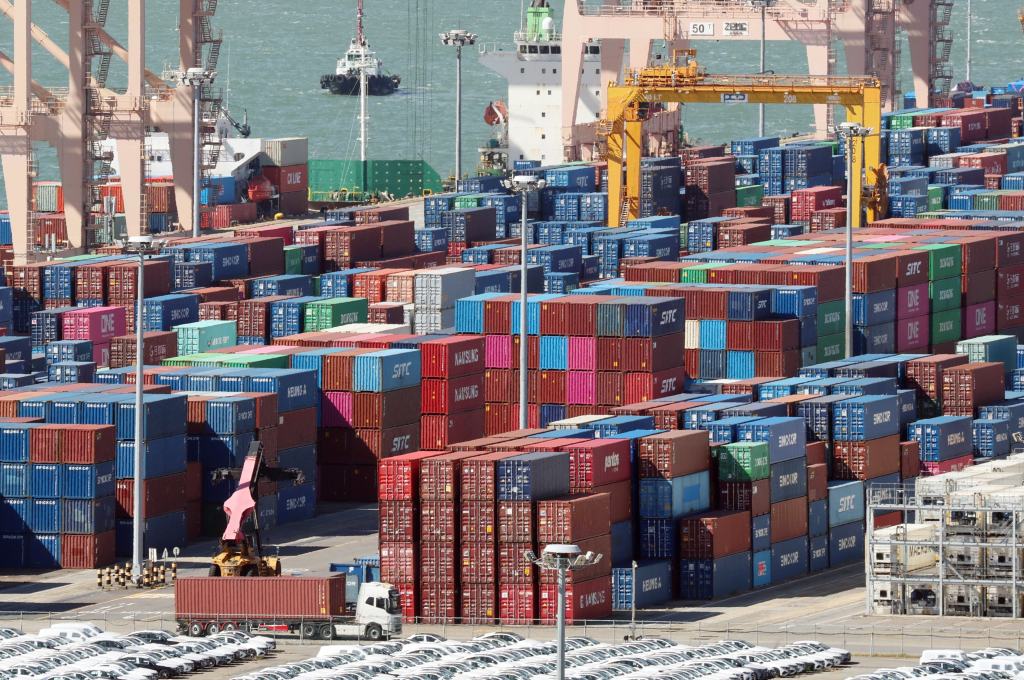
The growing current account surplus has been led by the goods balance, driven by semiconductor exports. August’s goods surplus reached 46.81 billion dollars, surpassing 40 billion dollars for three consecutive months and ranking as the second-highest on record. This marked an increase of 36.1 billion dollars from the same month last year and 6.38 billion dollars from the previous month. The Bank of Korea explained, “Goods exports, led by semiconductors, have exceeded 100 billion dollars for three consecutive months, leading the current and goods account surpluses to set a new record high for the second time in a month.”
Exports of goods totaled 104.8 billion dollars, an 82.1% increase from the same month last year. By category, semiconductor exports surged 206.1% compared to the previous year, while IT-related product exports jumped 162.6%. Exports of petroleum products and chemical goods also saw high growth rates of 64.9% and 14.1%, respectively, compared to the previous year.
Imports of raw materials and capital goods increased by 13.1% and 42.9%, respectively, bringing total goods imports to 57.99 billion dollars, a 23.8% rise from the previous year. Consumer goods imports, which had declined in the previous month, turned to a 4.3% increase.
The service account recorded a deficit of 1.68 billion dollars in August, as the travel account, which had seen two consecutive months of surplus until June, remained in deficit for the second consecutive month following July. The Bank of Korea stated, “The travel account deficit widened to 770 million dollars from 340 million dollars the previous month due to increased outbound travelers during the peak travel season.” The number of outbound travelers in August was 2.432 million people, up from 2.419 million people the previous month. The deficit in royalties for intellectual property rights narrowed to 390 million dollars from 540 million dollars the previous month, as income from industrial property rights exceeded payments.
Meanwhile, the financial account net assets increased by 40.23 billion dollars in August, slightly down from 40.32 billion dollars the previous month. According to the Bank of Korea’s balance of payments statistics, the financial account net assets increase when Koreans’ overseas investments (assets) grow or foreign investments in Korea (liabilities) decrease.
The Bank of Korea explained, “While the increase in overseas stock assets by the government and corporations narrowed from 12.33 billion dollars the previous month to 10.15 billion dollars, overseas bond investments rose by 6.44 billion dollars, marking the largest increase on record.” This reflects increased Korean investment in overseas bonds as U.S. Treasury yields rose, driving down bond prices.
Overall net assets from securities investment, combining stocks and bonds, increased by 21.44 billion dollars, a significant expansion from the previous month’s 5.4 billion dollars. The cumulative increase in financial account net assets from January to August reached 249.22 billion dollars, 3.9 times the 64.4 billion dollars recorded during the same period last year.





Leave a comment