
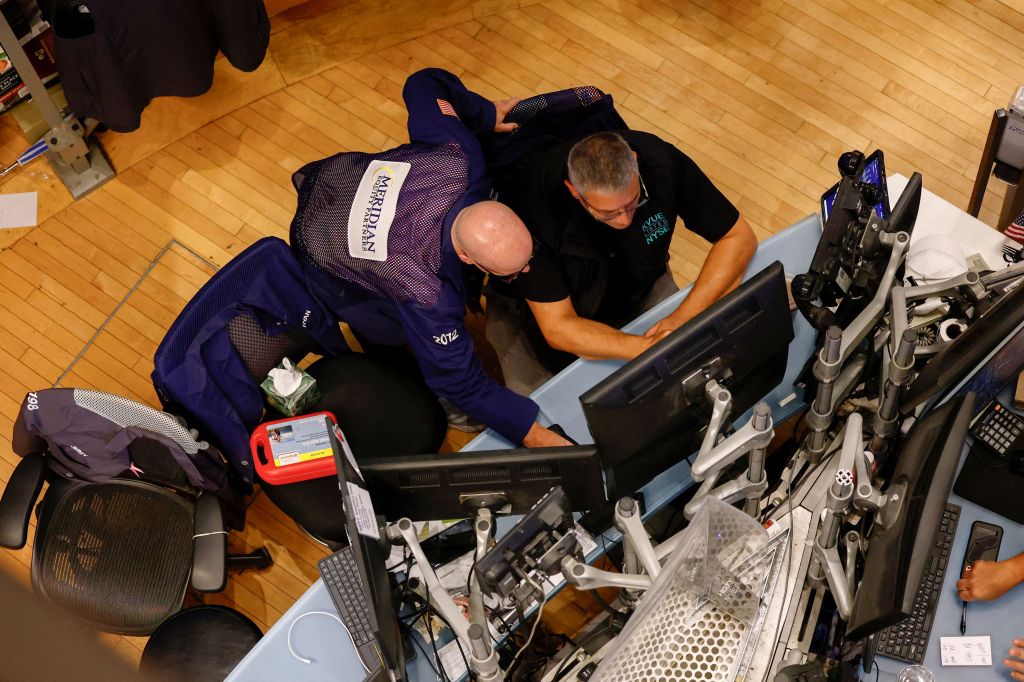
The three major U.S. stock indices on Wall Street fell on the 7th (local time). Investor sentiment weakened as long-term U.S. Treasury yields surged to their highest levels in 24 years. However, strong demand in the Treasury auction helped pull yields down from intraday highs, and a decline in international oil prices limited the market’s losses.
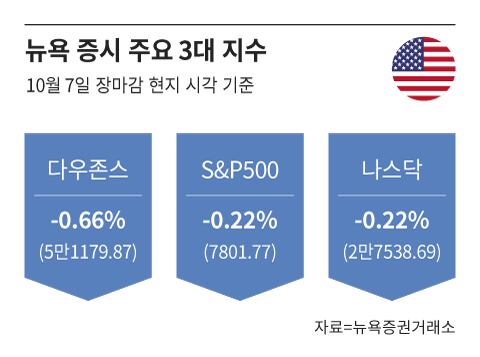
On the day, the Dow Jones Industrial Average closed at 51,179.87, down 341.41 points (0.66%) from the previous session. The S&P 500 fell 17.16 points (0.22%) to 7,801.77, and the Nasdaq dropped 61.20 points (0.22%) to 27,538.69. Both the S&P 500 and Nasdaq retreated from their record highs set the previous day.
Long-term interest rates pressured the market. The yield on the 10-year U.S. Treasury note rose to 5.365% during trading, marking its highest level since April 2002. The 30-year yield also climbed to 5.732%, the highest since May 2002. Concerns over inflation due to rising oil prices and the burden of expanded U.S. government spending have driven Treasury yields upward.
The rise in rates weighed on both financial and tech stocks. Goldman Sachs and Bank of America each fell around 1%, while Wells Fargo, Citigroup, and JP Morgan also declined. CrowdStrike dropped over 5%, and Palo Alto Networks fell more than 3%, as higher borrowing costs could strain AI infrastructure investments. Meta also slid over 2%.
However, the Treasury Department’s auction of $39 billion in 10-year notes put a brake on the yield surge. Strong demand at elevated rates pulled the 10-year yield back to around 5.28%, allowing stocks to partially recover their losses. The auction’s yield of 5.3% was the highest since 2000.
Falling oil prices also eased pressure on equities. The International Energy Agency’s (IEA) decision to accelerate oil reserve releases pushed November-delivery West Texas Intermediate (WTI) crude down $1.16 (1.3%) to $88.28 per barrel. December-delivery Brent crude settled at $100.2 per barrel, down $0.38 (0.38%).
The Federal Reserve’s September Federal Open Market Committee (FOMC) meeting minutes, released the same day, reaffirmed the possibility of additional rate hikes before year-end. Most participants assessed that raising the benchmark rate once more by the end of the year would likely be appropriate. However, no specific timing was provided. Participants emphasized that they would approach each meeting with an open mind, and future decisions would depend on incoming data and its implications for economic projections.





Leave a comment